Le Havre
The Moon and the SunLe Havre is both a place of royal display and a maritime threshold in the narrative. Its streets carry the court toward the waterfront, where Yves de la Croix arrives with the captive sea monster; later, the port becomes the return destination Louis XIV orders before the search for Sherzad continues. The location thus joins the pageantry of the royal household to the expedition’s consequential encounters with the sea and its peoples.
Streets, Procession, and Courtly Display
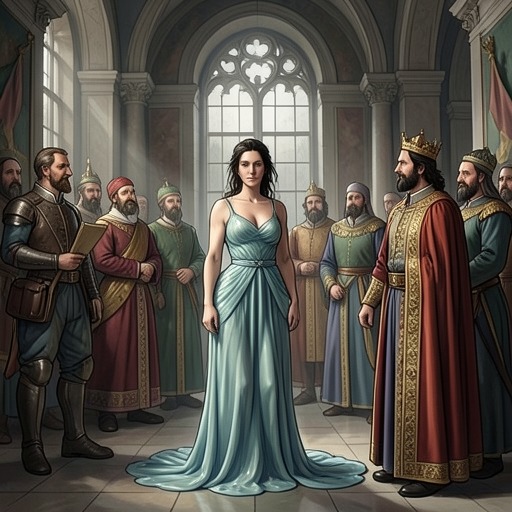
The court’s approach to Le Havre unfolds as a public spectacle. A procession fifty carriages long winds through a cobbled street while residents press close to cheer Louis XIV and his court. The display is measured through its visible abundance: ornate carriages and harnesses, jewels and lace, velvet and cloth of gold, and the broad plumed hats of young noblemen riding beside their sovereign. Le Havre is not merely a destination named on a route; its streets provide the public setting in which royal power is made visible to the people who gather to watch.
Marie-Josèphe de la Croix experiences that spectacle from inside the carriage of Monsieur and Madame, whose vehicle ranks second in magnificence only to the King’s. Mademoiselle d’Orléans, Lotte, sits beside her, while the Chevalier de Lorraine lounges nearby. The carriage’s place in the procession locates Marie-Josèphe within the court’s hierarchy, even as the crowds outside make the journey a public encounter. Her earlier dream of riding in such a procession has been surpassed by the reality of traveling in one of its most splendid vehicles. The narrative thereby sets her private response against the carefully ordered show of rank surrounding her.
The Waterfront and Yves’s Arrival
The procession leads toward the waterfront because Louis XIV wishes to meet his expedition there. Madame accompanies him as a member of his court, stepping into the street without publicly objecting to its dirt or smells. The distinction between public conduct and private opinion is part of the scene’s courtly setting: Le Havre’s streets are not polished ceremonial rooms, yet royal presence turns the journey through them into an occasion governed by public behavior.
At the harbor, the King’s galleon lies at the far end of the wharf, its sails furled and its lines secured. Golden horses leap from its stern, echoing the imagery of the royal procession and making the ship itself part of the display. Sailors unload Yves’s equipment and baggage. Then Yves comes down the gangplank in a long black robe, transformed in Marie-Josèphe’s eyes from the youth in homespun she remembers into a grown man, handsome, elegant, and severe. She longs to run to him, but what she has learned at Saint-Cyr and Versailles restrains her to a more sedate greeting. The dock is therefore the site of a family reunion shaped by the manners she has acquired away from home.
The arrival also introduces what Yves has brought back. Sailors carry a net suspended between shoulder-poles, supporting a gilded basin; Yves places his hand on its rim to steady it and keeps hold of it as he and the captain walk up the dock. The gesture presents the basin as both protected cargo and Yves’s possession. In retrospect, the scene records the moment he gave the captive sea monster to Louis XIV. Le Havre’s wharf thus marks the transfer of an extraordinary living captive from the expedition to the King, connecting the harbor’s ordinary work of receiving ships and cargo to the larger conflict over the sea people’s status and treatment.
A Port of Departure, Return, and Pursuit
Le Havre recurs in a later maritime sequence as the destination Louis XIV orders when the search for Sherzad appears to be ending. After a distant splash is identified by Marie-Josèphe as Sherzad, the captain initially calls it only a fish. The lure of treasure has not overcome his fears, but the King’s command compels him to sail in pursuit. When Sherzad leads the ship to a cove, the captain refuses to take the larger vessel inside, warning that the approach is treacherous and that they might not get out. A skiff is lowered instead; Louis XIV orders Marie-Josèphe to accompany him, and Lucien de Chrétien joins them despite the sailors’ objections.
The episode makes Le Havre a proposed point of retreat rather than a fixed endpoint. The order to return is overtaken by the sighting and the decision to pursue Sherzad, while the captain’s refusal to enter the cove establishes a practical limit on how far the ship can follow. From the port, the narrative’s movement between royal command and the hazards of the coast remains unresolved: the King can direct the vessel, but the channel and cove constrain its course.
Memory and Narrative Significance
Le Havre also becomes a measure of how much has changed since the expedition’s arrival. Later, as Marie-Josèphe and Lucien face a sea crossing from Martinique, Lucien suffers badly even in calm coastal waters. Marie-Josèphe worries about him as well as Sherzad, while Louis XIV shows no sympathy for either. Her conviction that the King takes malicious enjoyment in stripping Lucien of his position and blue coat connects the present voyage to the earlier courtly authority first encountered at Le Havre. The port is not stated to be the cause of their later losses; rather, the initial arrival there stands in contrast with the suffering and diminished status that follow.
That contrast is sharpened when Yves enters carrying his bag and Marie-Josèphe’s drawing box. Lucien recalls the last time he saw Yves smile: on the dock at Le Havre, when Yves gave the captive sea monster to the King. The remembered smile returns the narrative to the harbor’s first meeting between expedition, court, and captive. Le Havre consequently holds two linked images of Yves: the man who arrives in formal black, guarding the basin, and the earlier moment of happiness recalled amid later hardship. The location’s significance lies in this convergence of public spectacle, reunion, royal possession, and memory—not in a detailed account of the town beyond the streets, wharf, and harbor that the story shows.